

It’s interesting how many people are talking about different kinds of relationships these days. For a long time, it felt like everyone just assumed monogamy was the only way to go, especially when it came to serious partnerships. But for folks in the LGBTQ+ community, challenging those norms isn’t exactly new territory. We’ve always had to question what society tells us about love, sex, and family. So, it makes sense that exploring things like erotic polyamory dating would appeal to many in our community. It’s about finding what works for us, even if it’s outside the usual boxes. This article looks at why Erotic Polyamory Dating Appeals to LGBTQ+ Communities.
Key Takeaways
- Many in LGBTQ+ communities are already used to questioning traditional relationship rules, making polyamory a natural extension of that mindset.
- Erotic polyamory allows for a broader expression of love and sexuality, moving beyond strict, binary ideas about relationships.
- Being open and honest in polyamorous relationships mirrors the importance of sexual honesty and autonomy that’s valued in queer identities.
- For queer women, open relationships can offer a way to avoid codependency and reclaim agency, especially in a history where their desires were often ignored.
- Embracing fluidity in sexuality and relationships is becoming more common, with younger generations more open to non-monogamous structures and seeing sexuality as a key part of who they are.
Challenging Monogamous Norms Within LGBTQ+ Relationships
For a long time, monogamy was seen as the only valid option for serious relationships, especially within the LGBTQ+ community. The message was clear: a committed partnership meant exclusivity, and anything else was considered less legitimate. But for many of us, that model simply doesn’t fit. It can feel like being handed a script that leaves out our lines.
Challenging traditional ideas of commitment isn’t about rejecting it altogether—it’s about recognizing that commitment can take many forms. Increasingly, people in the LGBTQ+ community are discovering that non-monogamy often aligns more closely with their identities and desires.
This shift includes poly dating among gay and lesbian individuals who are questioning the pressure to conform to a one-size-fits-all model. These relationships are built on honesty, mutual respect, and adaptability, rather than rigid rules that may not serve everyone. Security doesn’t have to come from exclusivity—it can grow from trust, transparency, and ongoing communication.
Erotic Polyamory as an Extension of Queer Identity
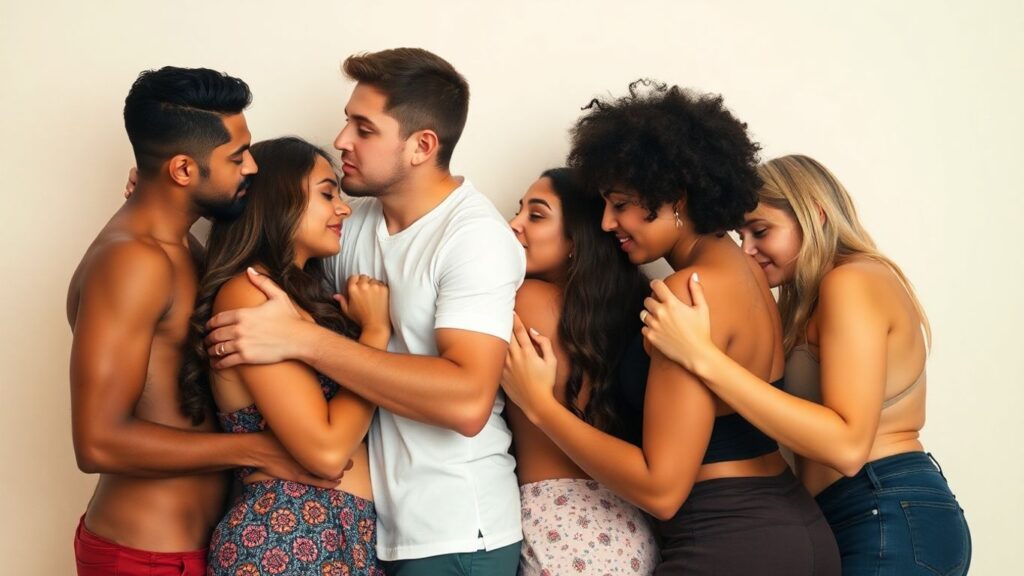
For many in the LGBTQ+ community, exploring erotic polyamory dating isn’t just a lifestyle choice. It’s a natural extension of queer identity itself. At its core, queerness often means rejecting rigid, binary thinking. That same openness extends to how love, relationships, and sexuality are understood.
Erotic connections in queer dating can take many forms. Polyamory provides a framework that supports this ethos of challenging norms and embracing diversity.
Exploring Diverse Forms of Love and Sexuality
Queer communities have always been at the forefront of questioning societal expectations around gender and relationships. This inherent questioning naturally leads to an openness to diverse expressions of love and sexuality. Erotic polyamory, with its emphasis on multiple consensual connections, mirrors this exploration. It’s about recognizing that love and attraction aren’t confined to a single person or a single prescribed path. This approach allows for a richer, more expansive experience of intimacy and desire, moving beyond traditional monogamous structures that may not fully capture the complexity of individual experiences.
Queerness as a Rejection of Binary Thinking
At its heart, queerness is about dismantling binaries – gay/straight, male/female, and yes, monogamous/non-monogamous. The very act of identifying as LGBTQ+ often means stepping outside of heteronormative and cisnormative expectations. Erotic polyamory dating fits perfectly within this paradigm. It challenges the idea that a relationship is only valid or complete if it’s strictly between two people. This aligns with the queer experience of creating our own definitions and finding validity in our unique paths, rather than conforming to societal molds.
Finding Community and Chosen Family Through Non-Monogamy
Many in the LGBTQ+ community have found chosen families and deep connections through shared experiences and understanding, especially when biological families or mainstream society haven’t been supportive. Non-monogamy, including polyamory, can foster similar bonds. Building relationships based on honesty, communication, and mutual respect, even when those relationships involve multiple partners, can create strong, supportive networks. These networks often function as chosen families, providing a sense of belonging and shared identity that is deeply affirming for those involved in lgbtq polyamory relationships.
Sexual Honesty and Autonomy in LGBTQ+ Polyamory
Prioritizing Truth and Trust in Relationships
In LGBTQ+ polyamory, truthfulness isn’t just a nice-to-have—it’s the foundation. Polyamorous folks are often upfront about what they want and feel, sometimes more so than in monogamous setups. Instead of quietly harboring attractions or desires, partners are encouraged to talk it out—awkwardness and all. Being honest about who you’re drawn to, or what you want, can strengthen the relationship more than pretending those feelings don’t exist. This approach can be awkward at first, but it becomes easier as trust builds.
Here’s how honesty shapes queer polyamorous relationships:
- Attraction is discussed openly, reducing the sting of secrecy.
- Trust becomes mutual and ongoing, not just a box you tick once at the start.
- Partners collaborate on boundaries, rather than following set rules.
If you’re curious how polyamorous relationships compare to other open dynamics, research shows that people in polyamorous relationships are generally seen as more responsible and thoughtful than swingers—have a look at this quick polyamory versus swinging comparison.
Reclaiming Female Desire and Agency
For queer women especially, polyamory can be about reclaiming the right to want, to desire, and to act on those feelings. There are old stereotypes that say women are less interested in sex, or should be passive. But many women and non-binary folks in polyamorous spaces push back: they get to want things, too. This means:
- Defining your own sexual and romantic needs, instead of fitting someone else’s narrative.
- Expecting partners to respect your agency and independence.
- Challenging double standards about jealousy and possessiveness—everyone has the same right to want and to act.
“Swingtowns is hands down the best community that I have had the pleasure to be a part of. Would recommend this website to anyone in the lifestyle!” -SlikRik1Ace
The Role of Self-Reflection in Relationship Evolution
Queer polyamory insists on a steady practice of checking in with yourself. Every so often, you ask: What do I want? What am I comfortable with? Is this arrangement working for me? This can be freeing, but it can also feel pretty raw. Sometimes it takes a few tries (or more) to get things right; honesty with yourself is as important as honesty with partners.
Steps that help keep a polyamorous relationship healthy:
- Regularly talk about boundaries and feelings—even (especially) when things are awkward.
- Give yourself permission to change your mind if something no longer feels right.
- Celebrate your growth, and don’t beat yourself up if things change or end—flexibility is key.
All in all, LGBTQ+ polyamory is less about chasing novelty, and more about creating an honest, self-aware partnership. It’s not always easy, and it isn’t for everyone, but for many, it’s the most authentic way of being together.
The Appeal of Open Relationships for Queer Women

For many queer women, the idea of open relationships isn’t just a different way to do dating; it feels like a natural extension of their identity. It’s about pushing back against rules that never really fit in the first place. Think about it: the whole idea of a couple being two people, exclusively, forever? That’s a pretty narrow box, and a lot of us in the queer community have always felt a bit cramped inside it.
Moving Beyond Codependency in Lesbian Partnerships
Sometimes, in lesbian relationships, there can be a tendency to lean on each other a little too much. It’s easy to get really close, and that’s great, but it can also lead to a kind of codependency. Open relationships can offer a way to keep that closeness while also allowing each person to have their own separate experiences and growth. It’s like saying, ‘I love you and I’m committed to you, but I’m also my own person with my own needs and desires.’ This can actually make the partnership stronger, not weaker.
Addressing Historical Exclusion in Polyamorous Movements
It’s also true that historically, discussions about non-monogamy, and polyamory specifically, have often centered on men or gay men. Queer women have sometimes felt left out of these conversations, or like their desires and experiences weren’t fully represented. Embracing open relationships is a way for queer women to reclaim space in these movements and to say that their needs for connection, intimacy, and sexual exploration are just as valid and important. It’s about making sure open relationships in the queer community include everyone.
Finding Freedom in Non-Traditional Relationship Models
Ultimately, for many queer women, choosing non-traditional relationship structures like open relationships is about freedom. It’s the freedom to define love and commitment on their own terms, rather than accepting a one-size-fits-all model. It’s about recognizing that there are many ways to build a fulfilling and honest connection with another person, and that exclusivity isn’t the only path to security or happiness. This exploration is a powerful act of self-determination.
Embracing Fluidity in Sexuality and Relationships

It feels like our generation is really starting to question a lot of the old rules about how relationships are supposed to work. For so long, it was just assumed that everyone would follow the same path: meet someone, get serious, maybe get married, and that’s that. But for many of us in the LGBTQ+ community, that path never really felt like ours to begin with. We’re realizing that there are so many different ways to love and connect, and that’s totally okay. It’s about finding what feels right for you, not what society tells you should be right.
Questioning Prescribed Relationship Paths
It’s easy to get caught up in what everyone else is doing, or what we’ve seen in movies and on TV. But when you step back, you realize that a lot of those scripts are inherited rather than chosen. We’re handed a narrow definition of love and commitment, and often told that deviation means failure.
Questioning these prescribed paths isn’t about rejecting relationships altogether—it’s about reclaiming the freedom to design them intentionally. For some, that might mean monogamy that’s consciously chosen rather than assumed. For others, it could mean exploring polyamory, open relationships, or other non-traditional structures.
The key is asking yourself: Does this model truly support who I am and what I want? By breaking away from default scripts, we give ourselves permission to create relationships rooted in authenticity, mutual respect, and growth.
Navigating the Landscape of Non-Monogamy
Stepping away from the familiar path of monogamy can feel like a big deal, right? It’s like everyone’s been given a map that only shows one route, and suddenly you’re looking at a whole atlas of possibilities. For many in the LGBTQ+ community, this exploration isn’t just about sex; it’s about embracing a broader sense of self and connection that often challenges the very foundations of traditional relationships. It’s not always easy, and honestly, it can be a bit scary at first. We’re so used to the idea that a serious relationship has to look a certain way, and breaking from that can bring up all sorts of feelings we weren’t expecting.
The Initial Fear of Deviating from the Norm
Let’s be real, the idea of not being monogamous can trigger some serious anxiety. We’ve been conditioned for so long to see monogamy as the ultimate sign of commitment and love. Thinking about other arrangements can feel like we’re somehow failing at relationships or being selfish. It’s like, if you’re not exclusively with one person, does that mean you don’t love them enough? Or worse, that you’re just looking for something on the side?
These fears are powerful because they tap into deeply ingrained cultural messages. But the truth is, love and commitment aren’t defined by exclusivity alone. Non-monogamy challenges us to rethink what loyalty, care, and intimacy actually mean. For many, stepping into polyamory or open relationships becomes less about rejecting love and more about expanding it—creating space for honesty, variety, and deeper trust.
Final Thoughts
Ultimately, exploring erotic polyamory is about more than just sex. For many in the LGBTQ+ community, it’s a way to challenge old ideas about relationships and love, much like coming out challenged ideas about sexuality. It’s about being honest with yourself and your partners, even when that feels a bit scary. It’s not about rejecting monogamy, but about recognizing that there are many paths to happiness and connection. This approach allows for a deeper exploration of desire and commitment, moving beyond societal expectations to build relationships that feel authentic and fulfilling. It’s a personal journey, and for some, it’s a path that leads to a richer, more honest way of loving.
Frequently Asked Questions
What is polyamory and why is it popular in LGBTQ+ communities?
Polyamory is about having more than one romantic or sexual relationship at the same time, with everyone involved knowing and agreeing. For LGBTQ+ people, it often feels like a natural fit because it challenges the usual rules about relationships that many in these communities have already questioned, like traditional ideas about gender and sexuality. It allows for more freedom to love and be loved in different ways.
How does polyamory connect with being queer?
Being queer often means not fitting into standard boxes, and polyamory is similar. It’s about exploring different ways to love and connect, rather than sticking to just one way. For many, it’s a way to express their identity and reject the idea that there’s only one ‘right’ way to have a relationship.
Is it hard to manage jealousy in polyamorous relationships?
Yes, jealousy can be tough. Even when you understand that your partner loves you and is attracted to others, seeing it happen can still bring up feelings of insecurity. However, many people in polyamorous relationships learn to talk about these feelings openly and work through them, seeing them as a chance to build deeper trust.
Why do some queer women find open relationships appealing?
Some queer women are drawn to open relationships because they offer a way to avoid becoming too dependent on a single partner. It can also be seen as a way to push back against historical trends where men often had multiple partners, but women’s desires were ignored. Open relationships can offer a sense of freedom and personal choice.
How important is honesty and communication in polyamory?
Honesty and clear communication are super important in polyamory. Everyone involved needs to know what’s going on and feel safe to share their feelings and boundaries. It’s about building trust through truth and making sure everyone feels respected and has a say in how the relationships work.
Is it scary to try non-monogamy for the first time?
It can definitely be scary to step away from the common idea of monogamy. Many people are taught that being with only one person is the only way to have a serious relationship. Trying something different, like polyamory, means facing fears and learning new ways to communicate and build trust, but it can lead to a deeper understanding of oneself and one’s relationships.
Expanding Love – Where Identity Meets Freedom
Erotic polyamory dating resonates strongly within LGBTQ+ communities because it creates space for love, desire, and connection outside rigid traditional models. It allows people to explore relationships that align with their identities, celebrate sexual freedom, and embrace diverse ways of building intimacy. For many, it’s not just about dating—it’s about finding community, acceptance, and authentic self-expression. Ready to see why so many are drawn to this lifestyle? Sign up today for your free SwingTowns account and connect with others who share your journey.
“The Swingtowns community has been a major source of inspiration for many years now and has become one of the most popular destinations for swing communities” -Thunderdicka


